

Author: Alicia Torres Niño
Agricultural Frontier: How has it been managed, and what can be done to reduce the impact on the high Andean forest and páramo ecosystems?
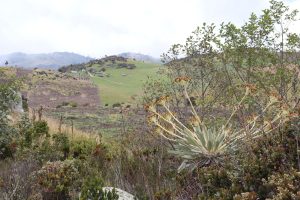
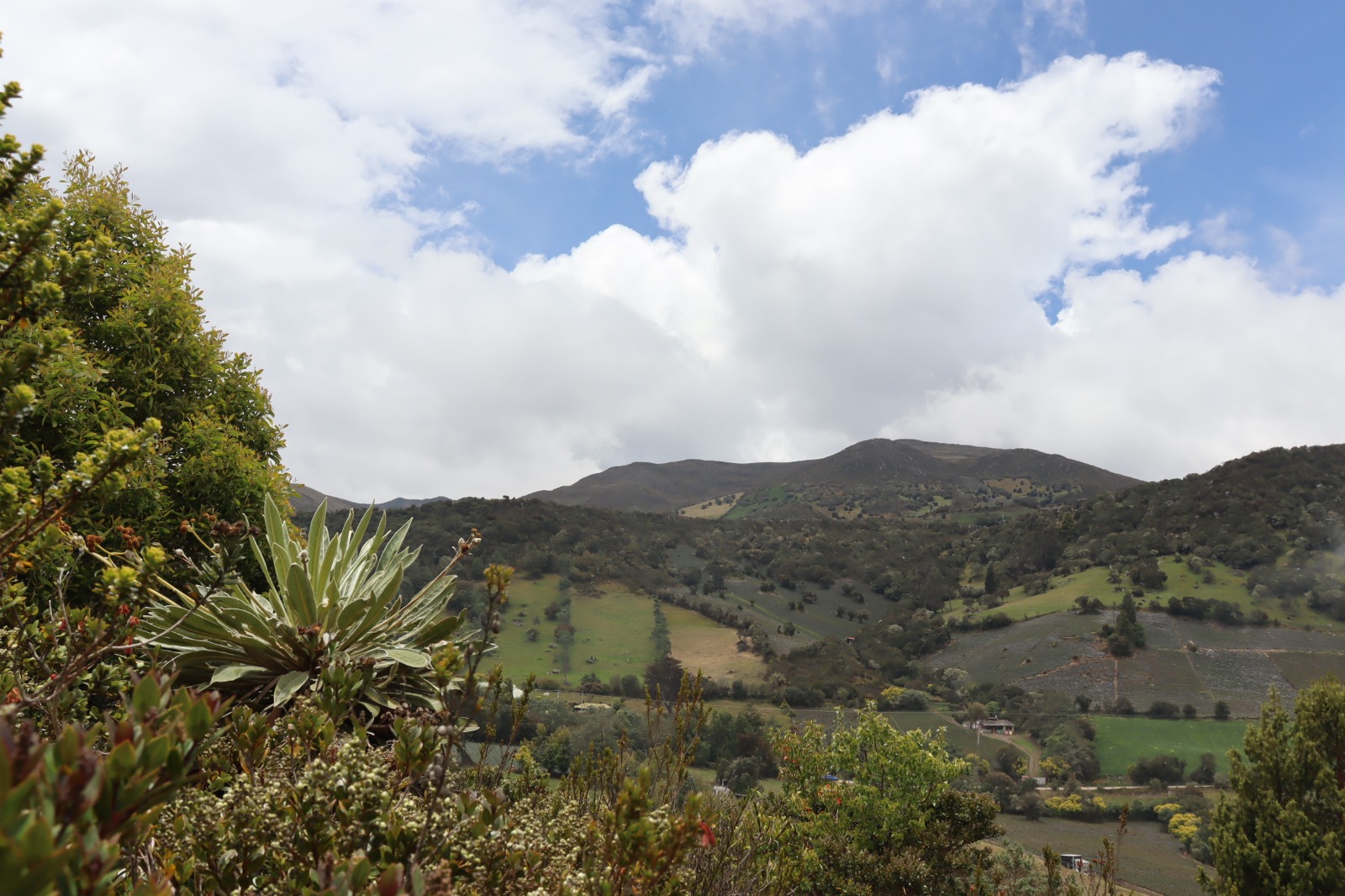
The municipality of Sibaté, Cundinamarca, is located within the buffer zone of the Sumapaz páramo, the largest páramo in the world. It contains different ecosystems such as high Andean forest, cloud forest, and páramo, which serve as habitats for various species of native fauna and flora. Currently, some of these species are at risk of threat due to the increase in agricultural production without proper control over these ecosystems.
Sibaté is also characterized as an agricultural territory, especially known for the production of potatoes, milk, and more recently, to a greater extent, strawberries. This production is facilitated by the fact that most of the territory is rural and is divided into 14 veredas (rural districts), with highly productive soil suitable for almost any type of crop.
However, in recent years there has been a marked increase in these agricultural activities, particularly strawberry cultivation, apparently without any control over areas that were once high Andean forests and páramo. This situation may pose a risk to the diversity of fauna and flora in the territory, as it is affected by monocultures, leaving in the distance the shadow of what was once native forest.
For this reason, this report is conducted to present the viewpoints of two male leaders and one female leader—peasant guardians of their territories—who, based on their experience and knowledge, share their opinions on how the agricultural frontier has been managed and what options could help reduce its impact.
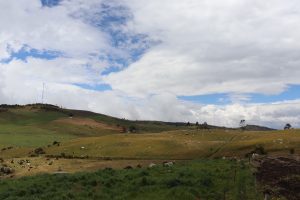
Hernán René Farías Fierro, a farmer from the Romeral vereda, member and founder of the agroecological peasant collective Achamas-Xiua, a zootechnician and specialist in Family Agriculture, explains that there is a lack of oversight by an entity responsible for monitoring how the agricultural frontier has been managed. He states, “I believe it has been handled very poorly because those areas where there is vegetation should already be zoned or clearly marked in order to prevent the expansion of the agricultural frontier.”
Páramo Law 1930 of 2018 outlines several reasons why it is important to halt the continued expansion of the agricultural frontier; however, it has not yet been fully enacted. At present, different working groups are being held with the community to review the law and propose requests, suggestions, and alternatives. René tells us: “In the working groups we have attended with the Ministry of Environment, I have strongly emphasized the relationship between the high Andean forest and the páramo, because in reality the high Andean forest serves as a buffer for what happens in the páramo,” René reiterates.
The transition zone is the entire ecosystem located between the high Andean forest and the páramo. “It allows the exchange of genetic material between the populations that live near the páramo and populations of the same species found lower down in the forest. So, in my personal view, protecting only the páramo is not enough; the high Andean forest must also be protected because of that exchange I mentioned.”
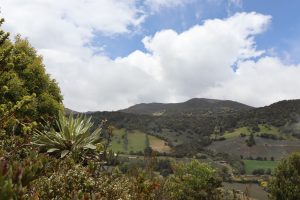
During the tour we conducted of René’s property, we identified several areas that he has designated for conservation. These areas were fenced off to allow them to remain free from any type of human intervention, and as a result they have been undergoing a natural restoration process. This is a practice that could be implemented on other farms that have productive activities; however, there is little evidence of interest from other landowners in doing so. Among the conservation and management options he proposes is the initiative of the Colombian agroecological movement. “We have to change the way we produce, and basically that is what the agroecological movement works on. We cannot continue to depend so heavily on external inputs on our farms, not only for environmental reasons but also for economic ones. If we look closely, people are selling their farms because that small-scale production—which institutions call small production and which we call family farming—can no longer survive in these territories due to its dependence on costly inputs.”
René states that this change must be promoted from within institutions through a different perspective, what science now calls a paradigm shift, which consists of changing the way things are done. Several of these alternative practices, which they refer to as “agricultures for life,” include agroecology, organic agriculture, and permaculture. “Agroecology brings together tools from all these forms of agriculture and places them in one framework, and when we talk about agroecology we do not focus only on agriculture, but also on social, environmental, and productive aspects.”
In this way, it is possible to achieve clean, affordable, and environmentally friendly production, which would reduce the impact left behind by the expansion of the agricultural frontier.
Communication with the ecosystem from a multidimensional perspective for its conservation
A resident of the Chacua vereda in the municipality of Sibaté, Natalia Romero is a community leader, educator, professional biologist, activist, and protector of her territory, as well as the coordinator of the community-based grassroots organization Delia. Today, she shares her perspective on how the municipality has been managing the expansion of the agricultural frontier and what options might help reduce its impact.
“I believe it is important to address this issue from a multidimensional perspective that includes historical, cultural, social, political, and, of course, environmental aspects, in order to better understand the problem,” Natalia states.
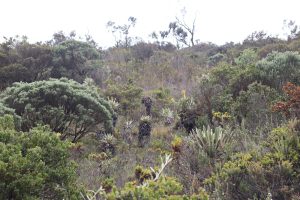
She explains that Sibaté, our municipality, is not immune to the national problem of land tenure—the concentration of land in very few hands. In Sibaté’s particular case, land is divided among a small number of families. Although this situation is not fully documented, based on what we know about our territory and through walking it and talking with our people, there is a clear expression of this inequality in rural land ownership. As mentioned earlier, land is held by only a few families, and this can be seen across the different veredas of the municipality. This form of land tenure creates a dynamic that drives the expansion of the agricultural frontier, affecting strategic ecosystems such as the high Andean forest and the páramo, which are key to water production and regulation.
“This land tenure, held by those who possess it—so to speak—comes with a purely productive vision and therefore a complete disconnection from the natural and cultural dynamics of the land or territory. From that perspective, when it comes to caring for the well, the spring, or the small patch of forest, production will always take precedence, and as a result the agricultural frontier will continue to expand,” Natalia states.
As this agricultural frontier expands, there will be greater fragmentation and loss of biodiversity—much of which is little known and not given the importance it deserves. Most inhabitants of the municipality are unaware of our biodiversity. From the perspective of soils, there will also be increased erosion and compaction, which will lead to a loss of soil nutrients.
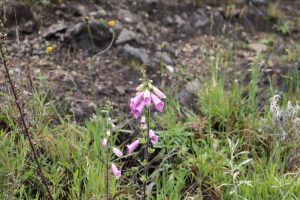
Natalia states that this completely changes and disrupts the dynamics of strategic ecosystems. Therefore, it is first necessary to approach the issue from an ecological point of view, recognizing that balance does not truly exist; instead, we speak of ecosystem dynamics. In this case, it is the dynamics inherent to forest and páramo ecosystems—a constant communication between ecosystems, a flow of information, matter, and energy with its own rhythms and patterns. These are altered, or will continue to be altered, as the agricultural frontier expands, to the point where ecosystems will cease to be resilient and we will reach a point of no return.
This is especially critical considering all the ecosystem services provided by the Andean forest and the páramo, such as biodiversity conservation, microclimate regulation, water supply, water regulation, carbon sequestration, and so on.
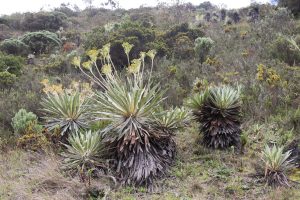
For this reason, it is important to maintain these dynamics, but in order to do so, we must first understand them. It is worth pointing out that in Sibaté we do not even have a baseline, which is fundamental when it comes to developing restoration and conservation strategies for these ecosystems that are so vital to us.
To return to the main point and also to conclude, it is worth considering other ways of producing and other ways of relating to the land, to the territory, so to speak, and to ecosystems. These options do exist and are supported by scientific evidence; however, we cannot consider them without also addressing other dimensions and aspects, as I mentioned earlier—social, political, and cultural—in order to reduce the impact of the agricultural frontier and, why not, to halt its expansion. That is what we must commit to and invest in, Natalia concludes.
Environmental education as a tool for conservation
Deogracias Jaimes (known as Maestro Páramo), a guardian of his territory, a farmer from the Bradamonte vereda, and a leader and environmental educator, states that people have not yet become aware of the importance of páramos and the negative impacts affecting our ecosystems. “People,” says Jaimes, “talk about resilience and about how we must adapt to climate change, but they do not talk about what we should do to prevent this from continuing, nor about the responsibility we have to conserve and protect our ecosystems. I believe the agricultural frontier is advancing at an accelerated pace because people are being pushed to increase food production.”
In addition to these factors, Deogracias points out the lack of knowledge and guidance from authorities when carrying out activities such as reforestation. As a result, exotic species have been introduced into the páramo, such as eugenias, myrtles (arrayanes), acacias, and gorse (retamo espinoso), which are displacing native páramo species.
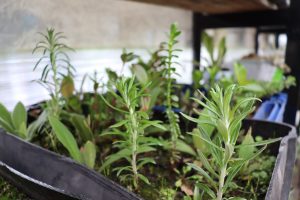
As part of the restoration and reforestation project led by Maestro Páramo, he carries out a process of collecting frailejón seeds, which he germinates and plants in his nursery to help reproduce these species. Alongside this work, he offers talks and environmental education workshops for girls, boys, and young people in educational institutions. He states:
“In the medium and long term, awareness must be built among young people and children. On many occasions, it is difficult to generate this dialogue with adults because these are production methods that have been passed down, and they are unwilling to change them. It is very important to use environmental education as a tool to understand the language of our páramos—how we can work in the páramo and how we can conserve it.”
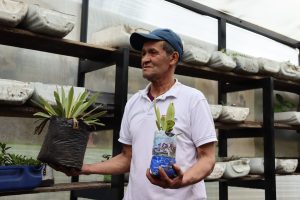
Additionally, Maestro Páramo carries out a process of recycling and reusing materials, such as milk bags, which he uses for planting seedlings in their early stages of growth. He emphasizes that maintaining balance within the ecosystem is essential in order to have a dignified life and to leave a future for coming generations. He invites us not to continue destroying the planet and to preserve the balance that depends on the five elements of the páramo: water, soil, flora, fauna, and hydrological systems. If one of these five elements disappears, nothing works and balance is lost.
He also stresses the importance of reclaiming our ancestral knowledge in order to achieve environmentally friendly production, respecting ecological balance through clean practices and returning to the use of native and ancestral seeds.